

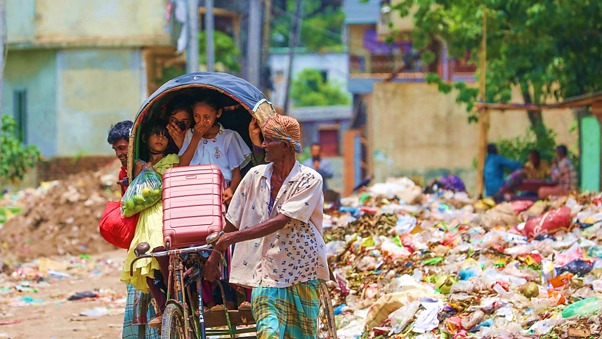
The foul smell from a roadside garbage pile may last only a
few minutes for a passer-by. For people living or working beside it, however,
it can persist throughout the day.
In 2026, Dhaka’s waste problem is no longer simply an issue
of cleanliness. It is an environmental, public-health and urban-management
challenge that can be understood through numbers.
Recent estimates indicate that the four city corporations
covering Dhaka, Gazipur and Narayanganj generate approximately 11,500 tonnes
of solid waste every day. Dhaka North and Dhaka South alone account for
around 6,500 tonnes per day. Roughly 75% of this waste is organic and
high in moisture, while collection efficiency is estimated at about 70–80%.
1
What do these numbers mean?
At 6,500 tonnes per day, Dhaka North and South generate
approximately 2.37 million tonnes of waste annually.
If around 75% is organic, that represents approximately 4,875
tonnes of biodegradable waste every day, or nearly 1.78 million tonnes
annually.
This is not merely waste. Properly separated, a significant
portion could become feedstock for composting, anaerobic digestion and other
resource-recovery systems.
Instead, organic waste is commonly mixed with plastics,
polythene, glass and other materials before collection and disposal.
2
The collection gap
If collection efficiency ranges between 70% and 80%, a
simple calculation suggests that 1,300–1,950 tonnes per day may remain
outside formal municipal collection.
This should not be interpreted as meaning that all of this
waste remains on roadsides. Some may enter informal recycling systems, while
some may be burned or disposed of in drains, vacant land and water bodies.
Nevertheless, the calculation illustrates the potential scale of the collection
challenge.
3
Why does Dhaka’s waste smell so bad?
The answer lies partly in its composition.
Wet food and other organic waste decompose rapidly in
Dhaka’s warm and humid conditions. When mixed waste remains in open containers,
roadside piles or transfer points, decomposition produces strong odours and
contaminated liquid, or leachate.
Rainfall makes the situation worse. Water passing through
decomposing waste can carry organic matter, nutrients and other contaminants
into drains, soil and nearby water bodies.
This turns a roadside waste problem into a wider
environmental-management issue.
4
Waste and urban flooding are connected
Even a small amount of improperly disposed waste can affect
drainage.
For illustration, if only 1% of Dhaka’s 6,500-tonne daily
waste stream entered drains or water bodies, that would equal around 65
tonnes per day, or nearly 23,700 tonnes annually.
This is an illustrative scenario, not a measured estimate.
But it demonstrates why plastic bags, bottles, packaging and other solid waste
can become significant obstacles within an already stressed drainage network.
Waste management, therefore, should be integrated into
Dhaka’s drainage and urban flood-management strategy.
5
Burning waste does not solve the problem
Open burning simply transfers pollution from land to air.
Burning mixed municipal waste can release fine particulate
matter and other harmful pollutants. In a city already struggling with serious
air pollution, uncontrolled waste burning represents another preventable source
of exposure.
We should not have to choose between breathing
decomposing waste on the street and breathing smoke from burning garbage.
6
The opportunity inside Dhaka’s waste
The estimated 75% organic fraction may actually be one of
the most important numbers.
If Dhaka generates approximately 4,875 tonnes of organic
waste daily, recovering even 20% would divert around 975 tonnes per
day, or more than 356,000 tonnes annually, from conventional
disposal.
This is why source segregation matters.
Households, restaurants, kitchen markets, hotels and
commercial establishments should gradually separate organic waste from
recyclable and residual materials. Market waste, in particular, offers
opportunities for dedicated organic-waste collection and treatment.
7
We need to measure performance
Dhaka’s waste-management performance should be evaluated
through transparent indicators: waste generated, collection efficiency,
recycling and composting rates, landfill disposal, illegal dumping points,
waste-burning incidents, transfer-station performance, leachate management and
public complaints resolved.
Dhaka does not need to make waste simply disappear from our
streets.
We need to know where it goes, how much is recovered, how
much reaches landfills, and what environmental cost we are paying along the way.
The smell on Dhaka’s roads is more than a nuisance.
It is a measurable warning that we must stop treating
waste as something to move away—and start managing it as a resource, a
public-health responsibility and an essential part of sustainable urban
management.
Share this page via